 Welcome to our first TennisAsia Monthly Newsletter ~ Sep 2026 ~ Why Matches Matter


CHAPTER 2 : THE START OF
SOMETHING NEW
A story about a young coach who tried harder to get things right, only to discover that good coaching starts with understanding the game his players are actually playing. (8 MIN READ)
The thought stayed with Tom longer than he expected.

Driving home after the Tuesday morning session, he kept returning to the woman by the net - the one who had thanked him, then asked whether next week they might work on what to do when both players were pinned behind the baseline.
He had said yes at once. Of course. Perfectly reasonable request.
But what unsettled him was not the question itself. It was the quiet realisation that in a full two hours on court, he had never really gone near it. He had worked on volleys, shape at net, earlier preparation, cleaner contact, all things he considered useful and relevant. Yet somehow he had missed the situation that, to her, seemed pressing enough to mention before she left.
Tom did what many good young coaches do when something feels slightly off: he assumed he needed to do better.
Not different, exactly. Better.
So the following Tuesday he came more prepared than usual, with a clearer plan and a stronger intention not to let the session drift into generalities.
If the women needed help in specific match situations, he would give it to them. If his coaching had been too broad before, he would make it more precise. If they needed more from him, they would have it.
Responsible coaching.
He started briskly. There was less meandering in the warm-up, less polite rallying while everyone settled.
He moved them quickly into doubles patterns. Feeding balls wide. Recovery reminders. Balls through the middle. Pinching the net.
If both players were back, one had to recognise the shorter ball and move forward sooner. If the return floated, they should know who was taking control of the point.
Tom explained each pattern clearly and with conviction. He demonstrated where needed, then set them to work.
To his eye, this was a better session already.
It was more focused. More intentional. Less woolly.
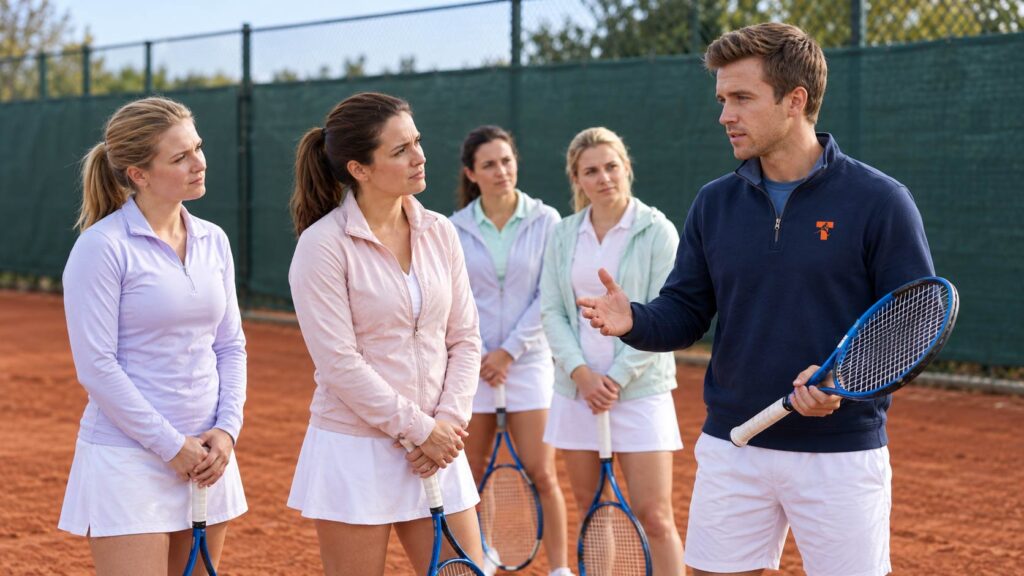
He gave more feedback than usual, and sooner. He stopped points to sharpen decisions, corrected court positions, reminded them to recover with purpose, to call earlier, to trust the higher-percentage ball. He repeated key ideas often enough that nobody could fail to understand what he meant.
He was energetic. Alert. Fully engaged.
No one could have accused him of being slack. The women responded as they always did: they listened, nodded, tried. And yet, after twenty minutes or so, the same feeling began again.
Not failure. Not resistance. Something subtler than that. The session was organised, but slightly airless. The women did what he asked, but without quite inhabiting it.
They grew more careful as he grew more exact.
Between feeds, they glanced at him a fraction longer, as if checking whether they had got it right. Some rushed the next shot after a correction. Some hesitated. Some smiled in that familiar, apologetic way players do when they feel they have done something wrong.
Tom kept going. He was not oblivious, but he did not yet know what else to do. If the point of confusion had not landed, perhaps it needed clearer delivery. If the pattern was still not taking hold, perhaps it needed repeating.
So he repeated it.
When one woman chose a high crosscourt ball instead of pressing forward through the middle, he stopped play and explained why the middle ball was the right one. When another stayed back rather than closing decisively behind a shorter reply, he replayed the same situation again.
He made the decisions simpler. He gave them the answer sooner.
Still, something on the court was not right. It felt forced. It felt harder.
What bothered Tom was that he was, by any ordinary standard, coaching well. He was attentive. Clear. Hard-working. He cared whether they improved. He was not neglecting them or patronising them or giving them anything less than his proper effort. If anything, he was trying harder than before to meet them where they were.
But the harder he worked to give them useful instruction, the less natural their tennis began to look.
Midway through the session, he set up a point beginning with both pairs behind the baseline. This, he thought, was exactly the sort of situation the woman at the net had meant. He fed a deep ball, then another, and the rally took shape. One player received a shorter ball and, instead of stepping in firmly through the middle as Tom had just outlined, she played a safer ball crosscourt and stayed in the rally.
Tom stopped the point.
He was ready with the correction. He could already hear himself giving it: if that ball sits up, you have to take control; if both opponents are back, the middle opens; if you keep giving away that chance, you give back control.
But before he spoke, he asked, almost incidentally, “What made you choose that shot?”
The woman answered at once.
“Because in our matches,” she said, “if I try to do too much from there, I usually miss. If I play high and crosscourt, we stay in the point and have a chance.”
There was no challenge in her tone. She was not arguing. She was simply explaining.
Tom nodded, though not immediately.

He had shown her the better option, as he saw it. A more assertive ball. A more correct use of the situation. Yet what she had given him in return was not disagreement but context: not what the shot should be in theory, but what the point felt like to her in the kind of match she actually played.
For a moment, neither of them said anything.
Then Tom dropped in another feed and carried on.
But the exchange stayed with him.
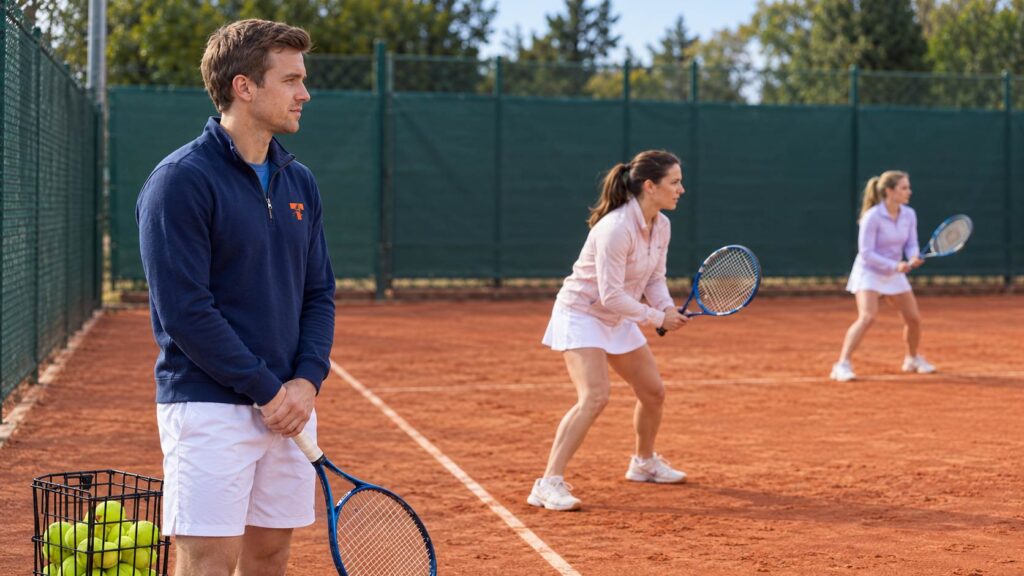
For the rest of the session he found himself noticing things he had previously treated as secondary: how often the women were trying to manage uncertainty rather than impose themselves; how much of their doubles was built not around ideal patterns but around imperfect balls, broken rhythms, half-opportunities, moments of hesitation and recovery; how often they were making choices not because those choices were tactically best, but because they were emotionally playable.
He did not yet have language for this. He certainly did not yet have a new method for approaching this.
What he had, by the end of the morning, was only a faint and unwelcome suspicion: that he was still teaching what ‘he’ thought was right, rather than the game they were actually playing.
And that giving them more of what he knew might not be the same as helping them with what they needed.